DaveMcK
Community Champion ⭐⭐⭐
May 2, 2019

NEW TOPIC: "FOR THE BIRDS"!

  • May 2, 2019
  • 129 replies
  • 71925 views

This is very simple! Find a picture or take a photo of a bird or group of birds. Then post it along with it's name, short information about it and photo credit if available. 


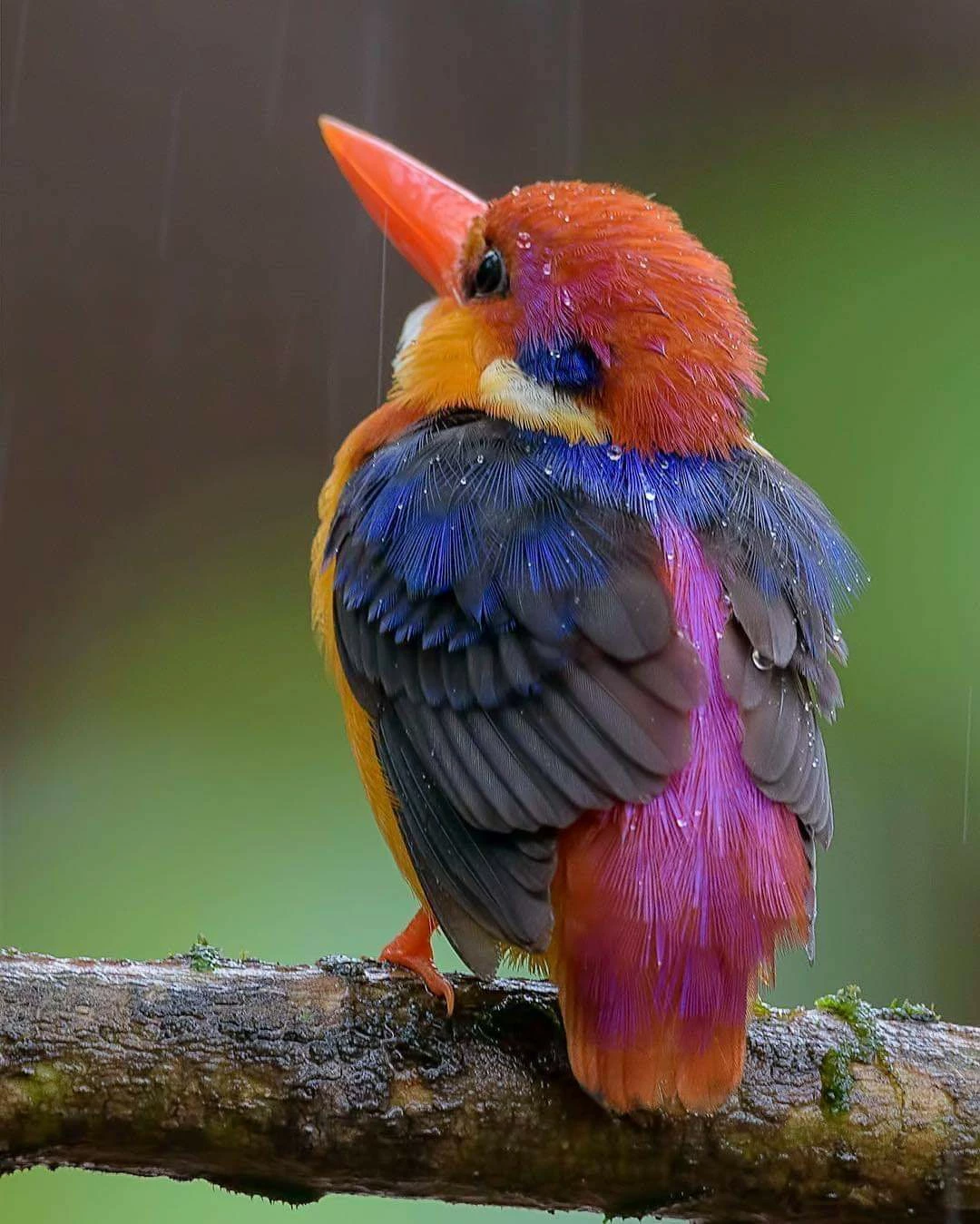
A gorgeous Dwarf Kingfisher enjoying the rain.

Credit: Rahul Belsare Photography.  

The Oriental dwarf kingfisher (Ceyx erithaca), also known as the black-backed kingfisher or three-toed kingfisher, is a species of bird in the family Alcedinidae. A widespread resident of lowland forest, it is endemic across much of the Indian subcontinent and Southeast Asia. It is found in BangladeshBhutanBruneiCambodiaIndiaIndonesiaLaosMalaysiaMyanmarSingaporeSri Lanka, and Thailand.


    This topic has been closed for replies.

    129 replies

    DaveMcK
    DaveMcKAuthor
    Community Champion ⭐⭐⭐
    July 21, 2019
    Posted by Dave the Lighthouse Keeper
    DaveMcK
    DaveMcKAuthor
    Community Champion ⭐⭐⭐
    July 26, 2019

    The brahminy kite (Haliastur indus), also known as the red-backed sea-eagle in Australia, is a medium-sized bird of prey in the family Accipitridae, which also includes many other diurnal raptors, such as eaglesbuzzards, and harriers. They are found in the Indian subcontinentSoutheast Asia, and Australia. They are found mainly on the coast and in inland wetlands, where they feed on dead fish and other prey. Adults have a reddish-brown body plumage contrasting with their white head and breast which make them easy to distinguish from other birds of prey.


    Posted by Dave the Lighthouse Keeper
    DaveMcK
    DaveMcKAuthor
    Community Champion ⭐⭐⭐
    August 6, 2019


    Glossy of bird terms
    External anatomy (topography) of a typical bird: 1 beak, 2 head, 3 iris, 4 pupil, 5 mantle, 6 lesser coverts, 7 scapulars, 8 coverts, 9 tertials, 10 rump, 11 primaries, 12 vent, 13 thigh, 14 tibio-tarsal articulation, 15 tarsus, 16 feet, 17 tibia, 18 belly, 19 flanks, 20 breast, 21 throat, 22 chin, 23 eyestripe

    The following is a glossary of common English language terms used in the description of birds—warm-blooded vertebrates of the class Aves, characterized by feathers, the ability to fly in all but the approximately 60 extant species of flightless birds, toothless, beaked jaws, the laying of hard-shelled eggs, a high metabolic rate, a four-chambered heart and a strong yet lightweight skeleton.

    Among other details such as size, proportions and shape, terms defining bird features developed and are used to describe features unique to the class—especially evolutionary adaptations that developed to aid flight. There are, for example, numerous terms describing the complex structural makeup of feathers (e.g., barbules, rachides and vanes); types of feathers (e.g., filoplume, pennaceous and plumulaceous feathers); and their growth and loss (e.g., colour morph, nuptial plumage and pterylosis).

    There are thousands of terms that are unique to the study of birds. This glossary makes no attempt to cover them all, concentrating on terms that might be found across descriptions of multiple bird species by bird enthusiasts and ornithologists. Though words that are not unique to birds are also covered, such as "back" or "belly", they are defined in relation to other unique features of external bird anatomy, sometimes called "topography". As a rule, this glossary does not contain individual entries on any of the approximately 9,700 recognized living individual bird species of the world.


    Link: https://en.m.wikipedia.org/wiki/Glossary_of_bird_terms


    I'm not a chicken!!


    Posted by Dave the Lighthouse Keeper
    Community Champion ⭐⭐
    August 21, 2019
    WHATEVER HE/SHE IS- BEAUTIFUL!
    SUPERGIRL, NO REALLY I MEAN IT! HER REAL NAME & MINE ARE THE SAME( FIRST 2 NAMES ARE)
    LydiaN586309
    Community Champion ⭐⭐⭐
    August 7, 2019

    I love this little fella's feet!  But they just don't look like they go with the rest of him.  Look's like he's wearin' a tuxedo with a pair of gym shoes. lol 

    LydiaN586309
    Community Champion ⭐⭐⭐
    August 20, 2019

    Image result for shoebill stork pictures

    These are Shoebill Storks The shoebill is a tall bird, with a typical height range of 110 to 140 cm (43 to 55 in) and some specimens reaching as much as 152 cm (60 in). Length from tail to beak can range from 100 to 140 cm (39 to 55 in) and wingspan is 230 to 260 cm (7 ft 7 in to 8 ft 6 in).  The shoebill (Balaeniceps rex) also known as whaleheadwhale-headed stork, or shoe-billed stork, is a very large stork-like bird. It derives its name from its enormous shoe-shaped bill. It has a somewhat stork-like overall form and has previously been classified with the storks. However, genetic evidence places it with the Pelecaniformes. The adult is mainly grey while the juveniles are browner. It lives in tropical east Africa in large swamps from Sudan to Zambia.


    Please check out the video below of a Shoebill Stork with his handler:

    https://hayhogi.vn/?qa=5070dce0330ace31/shoebill-stork-greeting-its-handler

    Community Champion ⭐⭐
    August 21, 2019
    A BEAUTIFUL CRITTER - SO GLAD TO SHARE THIS PLANET WITH THIS & OTHER AMAZING LIFE FORMS.
    SUPERGIRL, NO REALLY I MEAN IT! HER REAL NAME & MINE ARE THE SAME( FIRST 2 NAMES ARE)
    DaveMcK
    DaveMcKAuthor
    Community Champion ⭐⭐⭐
    August 21, 2019


    Penguins (order Sphenisciformesfamily Spheniscidae) are a group of aquatic flightless birds. They live almost exclusively in the Southern Hemisphere, with only one species, the Galapagos penguin, found north of the equator. Highly adapted for life in the water, penguins have countershaded dark and white plumage, and their wings have evolved into flippers. Most penguins feed on krillfishsquid and other forms of sea life which they catch while swimming underwater. They spend roughly half of their lives on land and the other half in the sea.

    Although almost all penguin species are native to the Southern Hemisphere, they are not found only in cold climates, such as Antarctica. In fact, only a few species of penguin live so far south. Several species are found in the temperate zone, and one species, the Galápagos penguin, lives near the equator.

    The largest living species is the emperor penguin(Aptenodytes forsteri😞[1] on average, adults are about 1.1 m (3 ft 7 in) tall and weigh 35 kg (77 lb). The smallest penguin species is the little blue penguin (Eudyptula minor), also known as the fairy penguin, which stands around 40 cm (16 in) tall and weighs 1 kg (2.2 lb). Among extant penguins, larger penguins inhabit colder regions, while smaller penguins are generally found in temperate or even tropical climates (see also Bergmann's rule). Some prehistoric species attained enormous sizes, becoming as tall or as heavy as an adult human. These were not restricted to Antarctic regions; on the contrary, subantarcticregions harboured high diversity, and at least one giant penguin occurred in a region around 2,000 km south of the equator 35 mya, in a climate decidedly warmer than today.

    Posted by Dave the Lighthouse Keeper
    Community Champion ⭐⭐
    August 22, 2019
    HAVE LOVED THESE CRITTERS SINCE SEEING "MARCH OF THE PENGUINS". THANKS FOR POSTING.
    SUPERGIRL, NO REALLY I MEAN IT! HER REAL NAME & MINE ARE THE SAME( FIRST 2 NAMES ARE)
    DaveMcK
    DaveMcKAuthor
    Community Champion ⭐⭐⭐
    August 29, 2019
    Peacocks
     

    COMMON NAME: Peacocks

    SCIENTIFIC NAME: Afropavo, Pavo

    TYPE: Birds

    DIET: Omnivores

    GROUP NAME: Muster, ostenstation, pride

    SIZE RELATIVE TO A 6-FT MAN:


    ABOUT PEACOCKS

    Peacocks are large, colorful pheasants (typically blue and green) known for their iridescent tails.

    Distinctive Tail Feathers

    These tail feathers, or coverts, spread out in a distinctive train that is more than 60 percent of the bird’s total body length and boast colorful "eye" markings of blue, gold, red, and other hues. The large train is used in mating rituals and courtship displays. It can be arched into a magnificent fan that reaches across the bird's back and touches the ground on either side. Females are believed to choose their mates according to the size, color, and quality of these outrageous feather trains.

    Males vs. Females

    The term "peacock" is commonly used to refer to birds of both sexes. Technically, only males are peacocks. Females are peahens, and together, they are called peafowl.

    Suitable males may gather harems of several females, each of which will lay three to five eggs. In fact, wild peafowl often roost in forest trees and gather in groups called parties.

    Population

    Peacocks are ground-feeders that eat insects, plants, and small creatures. There are two familiar peacock species. The blue peacock lives in India and Sri Lanka, while the green peacock is found in Java and Myanmar (Burma). A more distinct and little-known species, the Congo peacock, inhabits African rain forests.

    Peafowl such as the blue peacock have been admired by humans and kept as pets for thousands of years. Selective breeding has created some unusual color combinations, but wild birds are themselves bursting with vibrant hues. They can be testy and do not mix well with other domestic birds.

     
    Posted by Dave the Lighthouse Keeper
    LydiaN586309
    Community Champion ⭐⭐⭐
    September 1, 2019

    Beautiful...........................

    Community Champion ⭐⭐
    September 2, 2019
    BEAUTIFUL- HAVE HEARD THEY ARE VERY AGGRESSIVE BIRDS.
    SUPERGIRL, NO REALLY I MEAN IT! HER REAL NAME & MINE ARE THE SAME( FIRST 2 NAMES ARE)
    DaveMcK
    DaveMcKAuthor
    Community Champion ⭐⭐⭐
    September 7, 2019


    The red-tailed black cockatoo (Calyptorhynchus banksii) also known as Banksian- or Banks' black cockatoo, is a large black cockatoo native to Australia. Adult males have a characteristic pair of bright red panels on the tail that gives the species its name. It is more common in the drier parts of the continent. Five subspecies are recognised, differing most significantly in beak size. Although the more northerly subspecies are widespread, the two southern subspecies, the forest red-tailed black cockatoo and the south-eastern red-tailed black cockatoo are under threat.

    The species is usually found in eucalyptus woodlands, or along water courses. In the more northerly parts of the country, these cockatoos are commonly seen in large flocks. They are seed eaters and cavity nesters, and as such depend on trees with fairly large diameters, generally Eucalyptus. Populations in southeastern Australia are threatened by deforestationand other habitat alterations. Of the black cockatoos, the red-tailed is the most adaptable to aviculture,[2]although black cockatoos are much rarer and much more expensive in aviculture outside Australia.

    Posted by Dave the Lighthouse Keeper
    LydiaN586309
    Community Champion ⭐⭐⭐
    September 24, 2019


    Related imageThis is the Nicobar Pigeon

    Related imageNicobar pigeon

    The Nicobar pigeon is one of the closest living relatives to the dodo, a bird which is now extinct.

    This pigeon is found on the small islands and coastal regions from the Nicobar Islands, east through the Malay Archipelago, to the Solomons and Palau. The Nicobar is nomadic and they commute from island to island in flocks of up to 85 birds, to find food.

    Belfast Zoo’s Nicobar pigeons live in the rainforest house.

    Animal class
    Bird

    Habitat
    Forest

    Diet - Omnivore
    Nicobar pigeons eat seeds, often from harvested grain, fruit and some invertebrates.

    Size
    These pigeons can measure up to 40 centimetres long and weigh up to one pound.

    Image result for nicobar pigeon

    Location
    The species can be found in dense forest on small islands and in coastal regions from the Nicobar Islands located in Southeast Asia.

    Conservation status
    The IUCN believes that Nicobar pigeons will face extinction in the near future.

    Threats
    The biggest threats facing Nicobar pigeons are habitat destruction and being trapped or hunted for the food and pet trades.

    Current population
    The Nicobar pigeon population is declining but the species remains numerous at present.

    Zoo population
    There are currently 1,600 Nicobar pigeons living in zoos within Europe.


    Related image

    A truly beautiful and unusual bird

    Community Champion ⭐⭐
    September 24, 2019
    BEAUTIFUL- NEVER KNEW PIGEONS COULD BE SO COLORFUL.
    SUPERGIRL, NO REALLY I MEAN IT! HER REAL NAME & MINE ARE THE SAME( FIRST 2 NAMES ARE)
    DaveMcK
    DaveMcKAuthor
    Community Champion ⭐⭐⭐
    September 27, 2019
      There is no more appropriate fowl to cover their story in   the Fall than the migratory Canadian Geese!                                Canada Goose

    Branta canadensis

      Conservation statusFamilyHabitat  
    Species as a whole probably still increasing: responds well to management on wildlife refuges, and has become a common resident of city lakes and parks in many areas. Some distinctive populations are scarce or declining.
    Ducks and Geese
    Lakes, ponds, bays, marshes, fields. Very diverse, using different habitats in different regions; always nests near water, winters where feeding areas are within commuting distance of water. Nesting habitats include tundra, fresh marshes, salt marshes, lakes in wooded country. Often feeds in open fields, especially in winter. In recent years, also resident in city parks, suburban ponds.
    This big "Honker" is among our best-known waterfowl. In many regions, flights of Canada Geese passing over in V-formation -- northbound in spring, southbound in fall -- are universally recognized as signs of the changing seasons. Once considered a symbol of wilderness, this goose has adapted well to civilization, nesting around park ponds and golf courses; in a few places, it has even become something of a nuisance. Local forms vary greatly in size, and the smallest ones are now regarded as a separate species, Cackling Goose.
     
    Feeding Behavior

    forages mostly by grazing while walking on land; also feeds in water, submerging head and neck, sometimes up-ending. Feeds in flocks at most seasons.


    Eggs

    4-7, sometimes 2-11. White, becoming nest-stained. Incubation is by female, 25-28 days; male stands guard nearby. Young: Parents lead young from nest 1-2 days after hatching. Young are tended by both parents, but feed themselves. Age at first flight varies, usually 7-9 weeks, tending to be longer in the largest forms.


    Young

    Parents lead young from nest 1-2 days after hatching. Young are tended by both parents, but feed themselves. Age at first flight varies, usually 7-9 weeks, tending to be longer in the largest forms.

    Diet

    almost entirely plant material. Feeds on very wide variety of plants. Eats stems and shoots of grasses, sedges, aquatic plants, also seeds and berries; consumes many cultivated grains (especially on refuges, where crops planted for geese). Occasionally eats some insects, mollusks, crustaceans, sometimes small fish.


    Nesting

    May mate for life. Male defends territory with displays, including lowering head almost to ground with bill slightly raised and open, hissing; also pumps head up and down while standing. Nest site (chosen by female) is usually on slightly elevated dry ground near water, with good visibility. Much variation; may nest on cliff ledges, on muskrat houses, in trees, on artificial platforms. Nest (built by female) is slight depression with shallow bowl of sticks, grass, weeds, moss, lined with down.


    Migration

    Historically, each local population followed rigid migratory path, with traditional stopovers and wintering areas. Today many geese in urban areas and on refuges are permanent residents. Other populations have changed routes or wintering areas as habitats have changed.


         Link to full story:  https://www.audubon.org/field-guide/bird/canada-goose


    Posted by Dave the Lighthouse Keeper