DaveMcK
Community Champion ⭐⭐⭐
May 2, 2019

NEW TOPIC: "FOR THE BIRDS"!

  • May 2, 2019
  • 129 replies
  • 71931 views

This is very simple! Find a picture or take a photo of a bird or group of birds. Then post it along with it's name, short information about it and photo credit if available. 


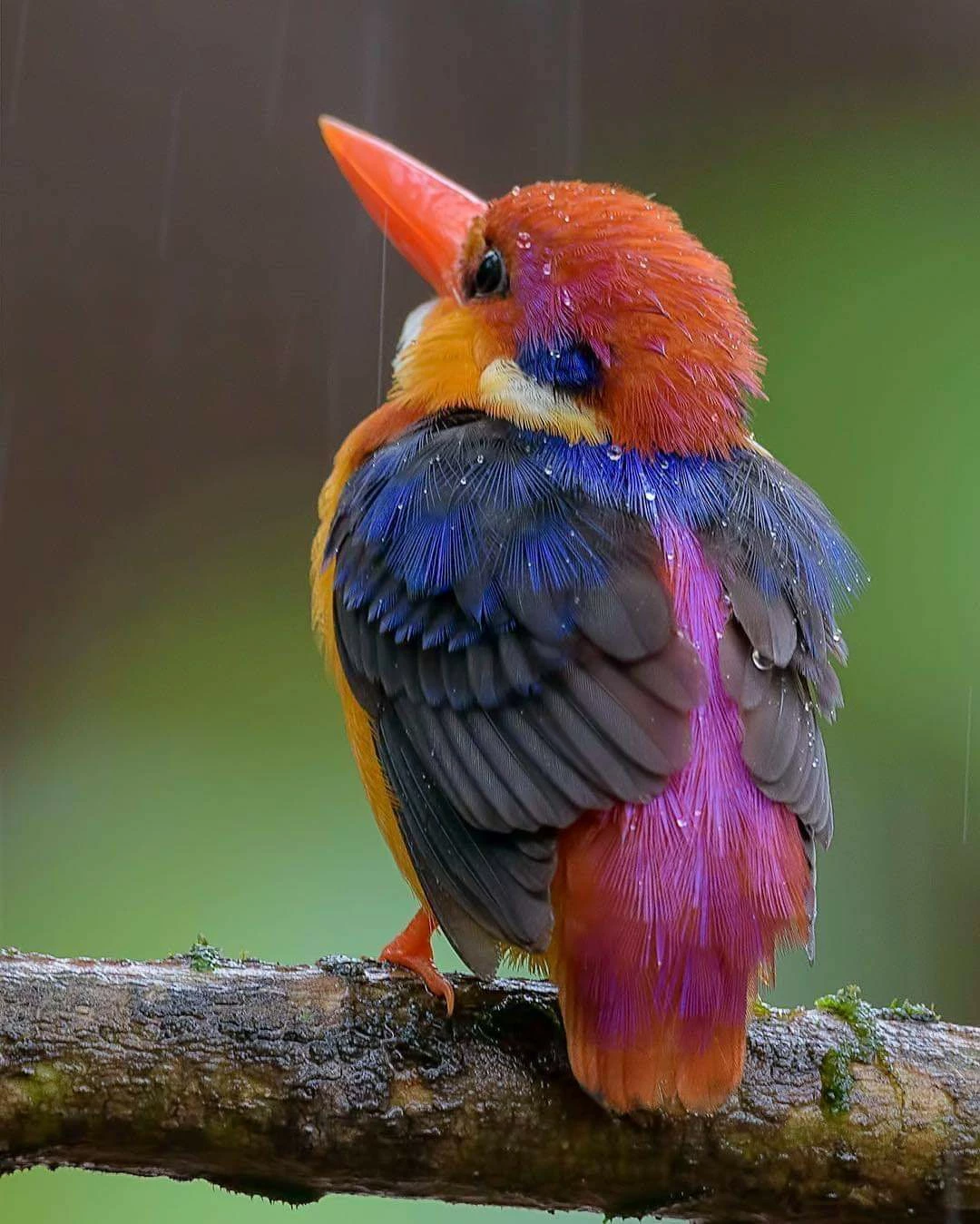
A gorgeous Dwarf Kingfisher enjoying the rain.

Credit: Rahul Belsare Photography.  

The Oriental dwarf kingfisher (Ceyx erithaca), also known as the black-backed kingfisher or three-toed kingfisher, is a species of bird in the family Alcedinidae. A widespread resident of lowland forest, it is endemic across much of the Indian subcontinent and Southeast Asia. It is found in BangladeshBhutanBruneiCambodiaIndiaIndonesiaLaosMalaysiaMyanmarSingaporeSri Lanka, and Thailand.


    This topic has been closed for replies.

    129 replies

    LydiaN586309
    Community Champion ⭐⭐⭐
    June 16, 2019

    This is a.......

    Image result for kookaburra

    KOOKABURRA also known as the Laughing Kookaburra.  Here's why:

    https://www.youtube.com/watch?v=UXA0-YAoo9Q


    ABOUT THE LAUGHING KOOKABURRA

    The laughing kookaburra is well known both as a symbol of Australia’s birdlife and as the inspirational “merry, merry king of the bush” from the children’s song.

    Characteristics

    Native to the eucalyptus forests of eastern Australia, the laughing kookaburra is the largest member of the Kingfisher family, with females weighing up to one pound and growing to 18 inches in length. Its beak can reach 4 inches long and is used to snatch a variety of invertebrates and small vertebrates, including the occasional small snake. Since being introduced in western Australia and New Zealand, the kookaburra has angered farmers by preying on their fowl.

    Image result for kookaburra

    The laughing kookaburra has dark brown wing plumage and a white head and underside. Dark brown eye stripes run across its face and its upper bill is black. Its reddish-colored tail is patterned with black bars.

    Laughter-Like Call

    It gets its moniker from its manic laughter-like call. And its early dawn and dusk cackling chorus earned it the nickname “bushman’s clock.”

    Related imagePopulation and Reproduction

    Laughing kookaburras are monogamous, territorial birds that nest in tree holes. Females lay one to five eggs, which are tended by a collective unit composed of parents and elder siblings. Fledgling kookaburras generally remain with their parents to help care for the subsequent clutch.

    Laughing kookaburras are not currently considered threatened although loss of habitat is a primary threat to the birds. They have adapted well to human development and often inhabit suburban areas, which provide both food and shelter.

     
    LydiaN586309
    Community Champion ⭐⭐⭐
    June 19, 2019

    I have been seeing this bird in my neighborhood so frequently, I thought I'd look it up and write        about it.  So here goes:

         American Goldfinch

    A typical summer sight is a male American Goldfinch flying over a meadow, flashing golden in the sun, calling perchickory as it bounds up and down in flight. In winter, when males and females alike are colored in subtler brown, flocks of goldfinches congregate in weedy fields and at feeders, making musical and plaintive calls. In most regions this is a late nester, beginning to nest in mid-summer, perhaps to assure a peak supply of late-summer seeds for feeding its young.


    Feeding Behavior

    Forages actively in weeds, shrubs, and trees, often climbing about acrobatically on plants such as thistles to reach the seeds. Except during breeding season, usually forages in flocks. Commonly comes to feeders for small seeds.


    Eggs

    4-6, sometimes 2-7. Pale bluish white, occasionally with light brown spots. Incubation is by female only, about 12-14 days. Male feeds female during incubation. Young: Both parents feed nestlings. At first male brings food, female gives it to young; then both parents feed; role of female gradually declines, so that male may provide most food in later stages. Young leave nest about 11-17 days after hatching.


    Young

    Both parents feed nestlings. At first male brings food, female gives it to young; then both parents feed; role of female gradually declines, so that male may provide most food in later stages. Young leave nest about 11-17 days after hatching.

    Diet

    Mostly seeds, some insects. Diet is primarily seeds, especially those of the daisy (composite) family, also those of weeds and grasses, and small seeds of trees such as elm, birch, and alder. Also eats buds, bark of young twigs, maple sap. Feeds on insects to a limited extent in summer. Young are fed regurgitated matter mostly made up of seeds.


    Nesting

    Nesting begins late in season in many areas, with most nesting activity during July and August. In courtship, male performs fluttering flight display while singing. Nest: Usually in deciduous shrubs or trees, sometimes in conifers or in dense weeds, usually less than 30' above the ground and placed in horizontal or upright fork. Nest (built by female) is a solid, compact cup of plant fibers, spiderwebs, plant down (especially from thistles); nest is so well-made that it may even hold water.


    LydiaN586309
    Community Champion ⭐⭐⭐
    June 21, 2019

    Image result for tanager

    Seven Colored Tanager

    The Seven-colored Tanager is decked out in eye-catching shades of turquoise, green, blue, yellow, and orange. It resembles the Green-headed Tanager, a species confusingly known as the Seven-colored Tanager (saíra-sete-cores) in Portuguese. The Seven-colored Tanager is found only in northeast Brazil and is closely related to other colorful birds found in that area, including the Gilt-edged Tanager.


    Image result for UNIQUE BIRDS


    This tanager has a small, fragmented range and a declining population, due to continued habitat lossand capture for the cage bird trade.

    Seven-colored Tanagers are usually seen in pairs or groups of up to four individuals, often in mixed-species flocks that forage through the forest canopy. Like other tropical tanagers, their diet is primarily made up of small fruits, berries, and seeds, plus the occasional insect.

    Image result for seven colored tanager pictures


    Fragmented Forest

    The Seven-colored Tanager's favored habitat is humid Atlantic coastal forests in northeastern Brazil, but this habitat has become quite rare. Eighty-five percent of the original Atlantic Forest has been cleared, and what remains exists only in small fragments.

    Other remnants of Atlantic Forest habitat are home to critically endangered birds found nowhere else, including Stresemann's Bristlefront and Banded Cotinga.

    Image result for seven colored tanager pictures

    Fortunately, the Seven-colored Tanager seems to adapt to secondary forest—sites where forests have been cut down and are now re-growing. But overall, the decline of the Seven-colored Tanager is an indicator of the poor state of the Atlantic Forest, where the species is thought to have once been much more abundant.


    --American Bird Conservancy

    LydiaN586309
    Community Champion ⭐⭐⭐
    June 23, 2019

    THE BLACK HERON

    Image result for pictures of black herons

    The black heron is a medium-sized (42.5–66 cm in height), black-plumaged heron with black bill, lores, legs and yellow feet. In breeding plumage it grows long plumes on the crown and nape.


    Image result for pictures of black herons

    Distribution and Habitat

    The black heron occurs patchily through Sub-Saharan Africa, from Senegal and Sudan to South Africa, but is found mainly on the eastern half of the continent and in Madasgacar. It has also been observed in Greece and Italy.

    It prefers shallow open waters, such as the edges of freshwater lakes and ponds. It may also be found in marshes, river edges, rice fields, and seasonally flooded grasslands. In coastal areas, it may be found feeding along tidal rivers and creeks, in alkaline lakes, and tidal flats.

    Habits

    The black heron uses a hunting method called canopy feeding—it uses its wings like an umbrella, creating shade that attracts fish.

    Image result for black herons

    WATCH:  The video below describes what the heron is doing in the picture above:

    https://www.audubon.org/news/watch-black-heron-fool-fish-turning-umbrella


    This technique was well documented on episode 5 of the BBC's The Life of Birds .  Some have been observed feeding in solitary, while others feed in groups of up to 50 individuals, 200 being the highest number reported. The black heron feeds by day but especially prefers the time around sunset. It roosts communally at night, and coastal flocks roost at high tide. The primary food of the black heron is small fish, but it will also eat aquatic insects, crustaceans and amphibians.

    The nest of the black heron is constructed of twigs placed over water in trees, bushes, and reed beds, forming a solid structure. The heron nests at the beginning of the rainy season, in single or mixed-species colonies that may number in the hundreds. The eggs are dark blue and the clutch is two to four eggs.

    DaveMcK
    DaveMcKAuthor
    Community Champion ⭐⭐⭐
    June 26, 2019

    The mourning dove (Zenaida macroura) is a member of the dove familyColumbidae. The bird is also known as the American mourning dove or the rain dove, and erroneously as the turtle dove, and was once known as the Carolina pigeon or Carolina turtledove.[2] It is one of the most abundant and widespread of all North American birds. It is also a leading gamebird, with more than 20 million birds (up to 70 million in some years) shot annually in the U.S., both for sport and for meat. Its ability to sustain its population under such pressure is due to its prolific breeding; in warm areas, one pair may raise up to six broods of two young each in a single year. The wings make an unusual whistling sound upon take-off and landing, a form of sonation. The bird is a strong flier, capable of speeds up to 88 km/h (55 mph). It is the national bird of the British Virgin Islands.

    Like other columbids, the mourning dove drinks by suction, without lifting or tilting its head. It often gathers at drinking spots around dawn and dusk.

    Mourning doves sunbathe or rainbathe by lying on the ground or on a flat tree limb, leaning over, stretching one wing, and keeping this posture for up to twenty minutes. These birds can also waterbathe in shallow pools or bird baths. Dustbathing is common as well.

    Mourning doves are light grey and brown and generally muted in color. Males and females are similar in appearance. The species is generally monogamous, with two squabs (young) per brood. Both parents incubate and care for the young. Mourning doves eat almost exclusively seeds, but the young are fed crop milk by their parents.

    The ranges of most of the subspecies overlap a little, with three in the United States or Canada.[6]The West Indian subspecies is found throughout the Greater Antilles.[7] It has recently invaded the Florida Keys.[6] The eastern subspecies is found mainly in eastern North America, as well as Bermuda and the Bahamas. The western subspecies is found in western North America, including parts of Mexico. The Panamanian subspecies is located in Central America. The Clarion Island subspecies is found only on Clarion Island, just off the Pacific coast of Mexico.[7]

    The mourning dove is sometimes called the "American mourning dove" to distinguish it from the distantly related mourning collared dove(Streptopelia decipiens) of Africa.[4] It was also formerly known as the "Carolina turtledove" and the "Carolina pigeon".[8] The genus name was bestowed in 1838 by French zoologist Charles L. Bonaparte in honor of his wife, Princess Zénaide, and macroura is from Ancient Greek makros, "long" and oura, "tail".[9] The "mourning" part of its common name comes from its call.


    Posted by Dave the Lighthouse Keeper
    DaveMcK
    DaveMcKAuthor
    Community Champion ⭐⭐⭐
    June 29, 2019
    LydiaN586309
    Community Champion ⭐⭐⭐
    June 30, 2019
    I find mourning doves in my backyard daily. They love feeding with the other fowls that my feeders attract. Simple and yet beautiful bird.
    Community Champion ⭐⭐
    July 1, 2019
    IS THERE AN EASY WAY TO TELL MORNING FROM TURTLE DOVES FROM PIGEONS? WHICH ONE MAKES A "COO-COO- CA-JOO" CALL? WHEN I HEAR IT, I'M SURE THAT'S WHERE JOHN & PAUL FOUND THEIR CHORUS FOR "I AM THE WALRUS"-"COO-COO- CA JOOB"!
    SUPERGIRL, NO REALLY I MEAN IT! HER REAL NAME & MINE ARE THE SAME( FIRST 2 NAMES ARE)
    DaveMcK
    DaveMcKAuthor
    Community Champion ⭐⭐⭐
    July 1, 2019

    Pigeons and doves constitute the animal family Columbidae and the order Columbiformes, which includes about 42 genera and 310 species. They are stout-bodied birds with short necks, and short slender bills that in some species feature fleshy ceres. They primarily feed on seeds, fruits, and plants. Pigeons and doves are likely the most common birds in the world; the family occurs worldwide, but the greatest variety is in the Indomalaya and Australasia ecozones.

    The distinction between "doves" and "pigeons" in English is not consistent, and does not exist in most other languages. In everyday speech, "dove" frequently indicates a pigeon that is white or nearly white; some people use the terms "dove" and "pigeon" interchangeably. In contrast, in scientific and ornithological practice, "dove" tends to be used for smaller species and "pigeon" for larger ones, but this is in no way consistently applied. Historically, the common names for these birds involve a great deal of variation between the terms. The species most commonly referred to as "pigeon" is the species known by scientists as the rock dove, one subspecies of which, the domestic pigeon, is common in many cities as the feral pigeon.

    Pigeon is a French word that derives from the Latin pipio, for a "peeping" chick,[2] while dove is a Germanic word that refers to the bird's diving flight.[3] The English dialectal word "culver" appears to derive from Latin columba.[2]

    Doves and pigeons build relatively flimsy nests, often using sticks and other debris, which may be placed on trees, ledges, or the ground, depending on species. They lay one or two eggs at a time, and both parents care for the young, which leave the nest after 7–28 days.[4] Unlike most birds, both sexes of doves and pigeons produce "crop milk" to feed to their young, secreted by a sloughing of fluid-filled cells from the lining of the crop. Young doves and pigeons are called "squabs".


    Posted by Dave the Lighthouse Keeper
    Community Champion ⭐⭐
    July 2, 2019
    THANK YOU FOR THE CLARIFICATION. WHAT ABOUT THE "COO-COO-CA-JOO" CALL? AM I LIKELY TO SEE/HEAR THESE BIRDS IN NORTH TEXAS YEAR-ROUND?
    ( INNER CITY?) WILL TRY THE APP.
    SUPERGIRL, NO REALLY I MEAN IT! HER REAL NAME & MINE ARE THE SAME( FIRST 2 NAMES ARE)
    LydiaN586309
    Community Champion ⭐⭐⭐
    July 2, 2019

    Image result for owl


    Image result for owl


    Image result for owl


    Image result for owl


    Related image


    Image result for owl


    Image result for owl


    Related image


    The subject here is The Owl.  Here are some quick-facts:


    • There are around 200 different owl species as we can see from the small sampling above.

    • Owls are active at night (nocturnal).

    • A group of owls is called a parliament.

    • Most owls hunt insects, small mammals and other birds.

    • Some owl species hunt fish.

    • Owls have powerful talons (claws) which help them catch and kill prey.

    • Owls have large eyes and a flat face.

    • Owls can turn their heads as much as 270 degrees.

    • Owls are farsighted, meaning they can’t see things close to their eyes clearly.

    • Owls are very quiet in flight compared to other birds of prey.

    • The color of owl’s feathers helps them blend into their environment (camouflage).

    • Barn owls can be recognized by their heart shaped face.

    The sounds of various owls:

    https://www.youtube.com/watch?v=ezaBqCf0hv0

    Owls in flight:

    https://www.youtube.com/watch?v=6pWub12DUoU

    Community Champion ⭐⭐
    July 3, 2019
    THANKS FOR SHARING SO MUCH ABOUT THESE BEAUTIFUL CRITTERS- NEVER THOUGHT TO LOOK FORT HEM IN MY INNER CITY NEIGHBORHOOD UNTIL ONE DAY I OPENED BACK DOOR & LOOKED AT DEAD TRUMPET VINE, GIANT BIRD HABITAT, FOR CARDINALS AS USUAL& SAW THE BLACK/GREY UNMISTAKABLE SHAPE OF AN OWL BACK ! NOW I KNOW TO LOOK FOR THEM. BARN OWLS IN INNER CITY?
    SUPERGIRL, NO REALLY I MEAN IT! HER REAL NAME & MINE ARE THE SAME( FIRST 2 NAMES ARE)
    LydiaN586309
    Community Champion ⭐⭐⭐
    July 12, 2019

    White-breasted Nuthatch Adult


    Birds of North America


    Image result for White-breasted nuthatch

    The White-Breasted Nuthatch

    A common feeder bird with clean black, gray, and white markings, White-breasted Nuthatches are active, agile little birds with an appetite for insects and large, meaty seeds. They get their common name from their habit of jamming large nuts and acorns into tree bark, then whacking them with their sharp bill to “hatch” out the seed from the inside. White-breasted Nuthatches may be small but their voices are loud, and often their insistent nasal yammering will lead you right to them.


    The White-breasted Nuthatch is normally territorial throughout the year, with pairs staying together. The male has to spend more time looking out for predators when he’s alone than while he’s with his mate. That’s the pattern for most birds, and one reason why birds spend so much time in flocks. But the female nuthatch has to put up with the male pushing her aside from foraging sites, so she spends more time looking around (for him) when he’s around than when she is alone.


    In winter, White-breasted Nuthatches join foraging flocks led by chickadees or titmice, perhaps partly because it makes food easier to find and partly because more birds can keep an eye out for predators. One study found that when titmice were removed from a flock, nuthatches were more wary and less willing to visit exposed bird feeders.


    If you see a White-breasted Nuthatch making lots of quick trips to and from your feeder – too many for it to be eating them all – it may be storing the seeds for later in the winter, by wedging them into furrows in the bark of nearby trees.


    The oldest known White-breasted Nuthatch was at least 9 years, 9 months old when it was found in Colorado.

    Community Champion ⭐⭐
    July 12, 2019
    DO YOU KNOW IF THESE BIRDS WOULD BE FOUND IN NORTH TEXAS? OR THE SOUTHERN PLAINS? COULD THEIR ACTIVITIES SOUND LIKE A WOODPECKER?
    SUPERGIRL, NO REALLY I MEAN IT! HER REAL NAME & MINE ARE THE SAME( FIRST 2 NAMES ARE)
    LydiaN586309
    Community Champion ⭐⭐⭐
    July 14, 2019

    Dear @l483260l ,

    Here's an answer for your question:


    WHITE-BREASTED NUTHATCH  Sitta carolinensis

    White-breasted Nuthatches are small, insectivorous bark gleaners which also eat plant materials such as acorns and nuts. Although the species is generally resident, northern and western populations may irrupt in some years (Pravosudov and Grubb 1993). This nuthatch breeds in northeast Texas and the mountains of the Trans-Pecos with only one confirmed breeding record between, in the eastern Panhandle. These eastern and western population apparently belong to different groups described in the AOU Checklist of North American birds which identifies 3 groups (eastern, interior montane and Pacific Coast) with vocal, morphological and ecological differences (Am. Ornithol. Union 1998).

    DISTRIBUTION. During the 1987-1992 field work of the TBBA project, volunteers found most White-breasted Nuthatches in Texas breed in the Pineywoods, (mostly north and central parts) and adjacent portions of the Post Oak Savannah regions (see the region map in Lockwood and Freeman [2004]). Breeding was also confirmed in the Davis and Guadalupe mountains of the Trans–Pecos and in the eastern Panhandle. North American Breeding Bird Survey (BBS) data from 13 routes produce a map similar to the TBBA map with the highest relative abundance (1-3 nuthatches per route) in east Texas and averages of <1 per route around the area of highest abundance and in the Trans-Pecos mountains (Sauer et al. 2005).

    Texas is the southeast corner of this species range in eastern North American which extends west from Nova Scotia to Manitoba and south to the Gulf Coast states. In western North America this species breeds from the Pacific Coast east to the Black Hills of South Dakota and the Rocky Mountains and south to northern Baja California and though the highlands of mainland Mexico to the Isthmus of Tehuantepec (Howell and Webb 1995, Sauer 2005).

    SEASONAL OCCURRENCE. White- breasted Nuthatches are resident in their limited breeding areas in this state. The breeding season is from early March to late June, perhaps later. Eggs have been collected from March 26 to April 2 (Oberholser 1974). TBBA atlasers found recently fledged young as early as March 27 in east Texas. .

    In contrast to this data from the east, in Arizona atlasers found breeding evidence for this nuthatch mostly between late April and the end of July (Spence 2004), suggesting the possibility eastern and western populations of this nuthatch have different breeding phenologies and that White-breasted Nuthatch in the Trans-Pecos mountains may breed at a different time than in the Pineywoods.

    BREEDING HABITAT. Oberholser (1974) reports this nuthatch breeds from low elevations to as high as 2700 m (8500 ft) in Texas. In eastern North America, this species nests in deciduous or mixed deciduous/coniferous woodlands, often at edges or openings (Pravosudov and Grubb 1993). In the interior west in Arizona 70% o breeding records for this species came from coniferous forest habitats and 18% came from deciduous woodlands (Spence 2005), while in Colorado about 68% of breeding evidence came from coniferous habitats and 19% came from deciduous habitats (Kuennin 1998).

    White-breasted Nuthatches breed in natural cavities in trees, old woodpecker holes and occasionally nest boxes. The cavity is lined with various materials such as bark shreds, twigs, grasses, hair and feathers. In the cup she has formed, the female usually lays 7-8 (range 5-10) white eggs, usually spotted with reds or browns. The eggs look like those of the Red-breasted Nuthatch (S. canadensis) but are larger. The female, fed by the male, incubates the eggs for 12-14 days and the young leave the nest 26 days after hatching and then stay with their parents for several weeks. Only one brood is raised per year and brood parasitism is rare (Harrison 1979, Pravosudov and Grubb 1993).

    STATUS. The species formerly bred on the Edwards Plateau and in the Big Bend area as well as further west and south in eastern Texas. Much of this range contraction apparently occurred before 1950 (Oberholser 1974). Currently White-breasted Nuthatch is considered locally uncommon in northeast Texas and common to uncommon in the Trans-Pecos mountains (Lockwood and Freeman 2004).

    BBS data from Texas are too limited to provide a robust population trend estimate for 1980-2005, but data from 26 routes in adjacent Oklahoma produce a statistically significant +5.0% annual population change for that period. The statistically significant population trends derived from 1248 routes in eastern North America and 1824 across the United States and Canada are more modest, +1.1% and 1.3%, respectively, for the same period (Sauer et al. 2005). These figures suggest the current status of this species in Texas is probably at least stable.

    Text by Robert C. Tweit (2006)

    Texas Breeding Bird Atlas map

    Literature cited:

    American Ornithologists’ Union. 1998. Checklist of North American birds, 7th ed. Am, Ornithol. Union, Washington, DC.

    Harrison, H. H. 1979. A field guide to western birds’ nests. Houghton Mifflin, Boston, MA.

    Howell, S. N. G. and S. Webb. 1995. A guide to the birds of Mexico and northern Central America. Oxford University Press, New York.

    Kuenning, R. R. 1998. White-breasted Nuthatch (Sitta carolinensis). In Colorado breeding bird atlas, pp. 358-359 (H. E. Kingery, ed.). Colorado Bird Atlas Partnership, Denver.

    Lockwood, M. W. and B. Freeman. 2004. The TOS handbook of Texas birds. Texas A&M University Press, College Station.

    Oberholser, H. C. 1974. The bird life of Texas. University of Texas Press, Austin.

    Pravosudov, V. V. and T. C. Grubb, Jr. 1993. White-breasted Nuthatch (Sitta carolinensis). In The birds of North America, No. 54 (A. Poole and F. Gill, eds.). The Birds of North America, Inc., Philadelphia, PA.

    Sauer, J. R., J. E. Hines, and J. Fallon. 2005. The North American Breeding Bird Survey, results and analysis 1966-2005. Version 6.2 2006. USGS Patuxent Wildlife Research Center, Laurel MD < http://www.mbr-pwrc.usgs.gov/bbs>

    Spence, J. R. 2005. White-breasted Nuthatch (Sitta carolinensis). In Arizona breeding bird atlas. pp. 396-397 (T. E. Corman and C. Wise-Gervais, eds.). University of New Mexico Press, Albuquerque.

    DaveMcK
    DaveMcKAuthor
    Community Champion ⭐⭐⭐
    July 19, 2019

    Could these seven reasons make you love seagulls?

    Chip thieves. Noisy chip thieves. Noisy chip-stealing winged evil. Seagulls don’t have the best reputation. Seen by many as a blight wherever they’re found, they’d probably make a lot of people’s top ten things they could do without. However, they do have their fans. There is, after all, the Mobile Gull Appreciation Unit, a kitsch coastal treasure that celebrates all things gull. In an attempt to balance the scales against that one time a gull stole your lunch, here are seven reasons why seagulls are actually not all that bad. 
    Mark Dion, Mobile Gull Appreciation Unit, commissioned by the Creative Foundation for Folkestone Triennial 2008.
     

    1. They keep rats at bay

    If it weren’t for gulls eating our waste, we’d probably have a lot more rats and rodents.

    2. They provide a soundtrack to our memories

    Even if their bolshiness isn’t appreciated, many people still love the sound of gulls at the seaside. Think of the herring gulls calling over the crashing waves in the Desert Island Discs signature tune.

    3. They are highly adaptable

    Gulls are masters of adaptability: that is why they have colonised our cities so successfully while struggling at the coast.

    Where their natural habitat has declined and food has diminished, seagulls are suffering. However those gulls which have migrated to cities, which provide safety as well as an abundance of food, have managed to thrive.

    Gulls are the kickass entrepreneurs of the avian world.

    Brett Westwood follows gulls away from the sea and explores how they thrive in cities and at the landfill sites where birders gather to watch and ring them.

    4. They have admirable traits

    Even though gulls display many emotions which we would see as positives in a person (competitive spirit, willing to seize an opportunity), we disparage them for these traits. While it’s never a pleasant experience to have your lunch dive-bombed, maybe we should look at it from their point of view.

    5. Spot the difference

    Gull species are extremely complicated to tell apart and mastering it is the bird-watching equivalent of being able to distinguish fine wines.

    6. They are more sinned against than sinning

    In a study of human/gull interactions, it was found that a human was far less likely to be "attacked" – ie chip stealing – by a gull than a gull was to be attacked by a human. One man in Bath was regularly seen standing naked on his balcony swinging a samurai sword to deter gulls from nesting near his flat – a technique researchers said would probably work in the short term but is legally dubious having in mind the indecent exposure; and, of course, the fact that nesting gulls are protected by law. Not many people know that...

    7. Yes, they can actually be cuddly

    Gull imagery is also commonly used in sports: teams such as Torquay United and Brighton & Hove Albion have them as mascots (Gilbert the Gull and Gully the Seagull, respectively). Others including Blackpool Seagulls and the Helsinki Seagulls name entire teams after them.


    Posted by Dave the Lighthouse Keeper