DaveMcK
Community Champion ⭐⭐⭐
May 2, 2019

NEW TOPIC: "FOR THE BIRDS"!

  • May 2, 2019
  • 129 replies
  • 72183 views

This is very simple! Find a picture or take a photo of a bird or group of birds. Then post it along with it's name, short information about it and photo credit if available. 


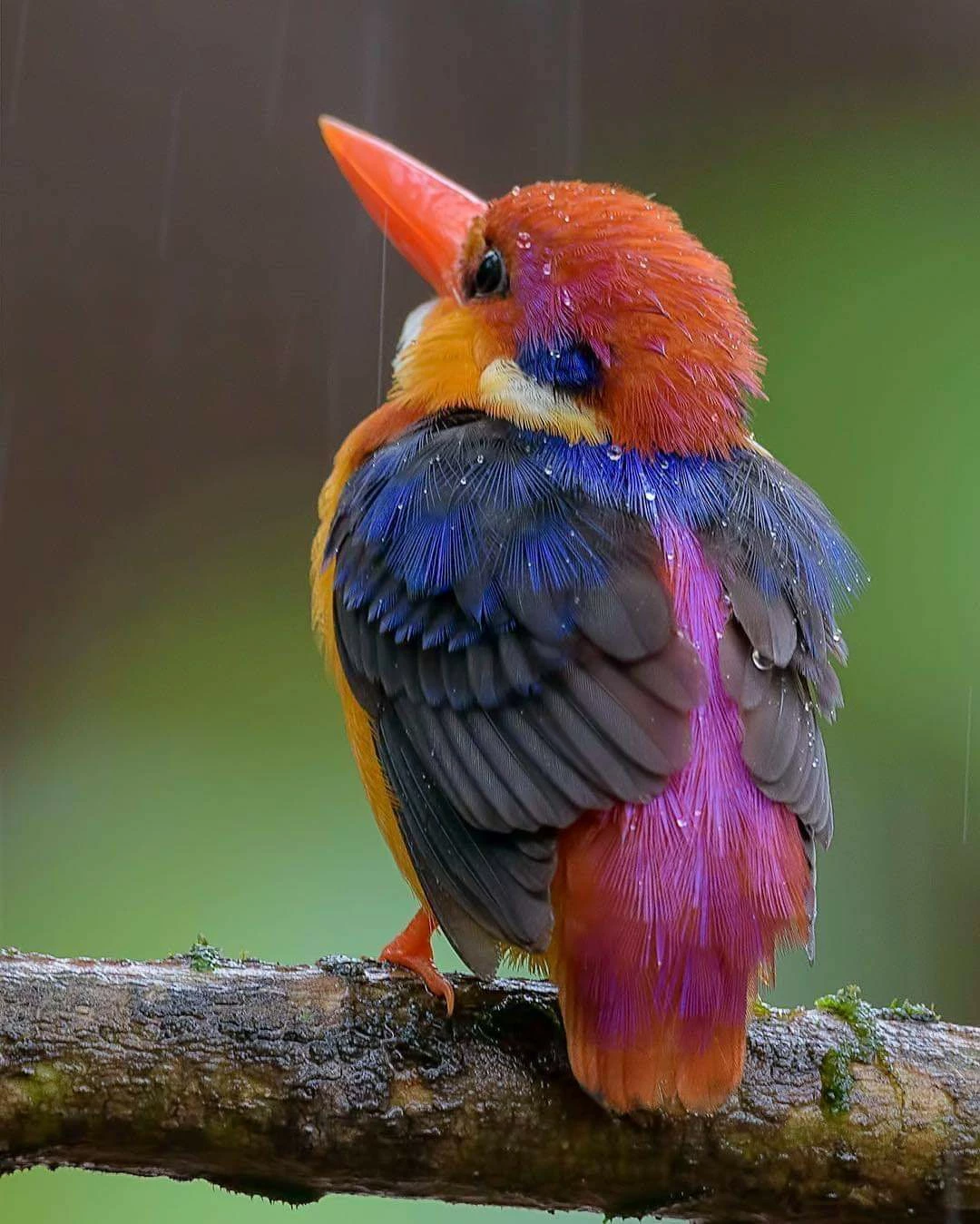
A gorgeous Dwarf Kingfisher enjoying the rain.

Credit: Rahul Belsare Photography.  

The Oriental dwarf kingfisher (Ceyx erithaca), also known as the black-backed kingfisher or three-toed kingfisher, is a species of bird in the family Alcedinidae. A widespread resident of lowland forest, it is endemic across much of the Indian subcontinent and Southeast Asia. It is found in BangladeshBhutanBruneiCambodiaIndiaIndonesiaLaosMalaysiaMyanmarSingaporeSri Lanka, and Thailand.


    This topic has been closed for replies.

    129 replies

    DaveMcK
    DaveMcKAuthor
    Community Champion ⭐⭐⭐
    January 2, 2021

    The dodo bird has been long extinct, but it still has relatives living in the world today. Known as the Nicobar pigeon, this rare creature is the closest living connection to the famous flightless bird, although the two don't look alike. One striking difference is the Nicobar pigeon’s vibrant plumage that shines in iridescent blues, coppers, and greens—in addition to its reddish legs and small white tail. This colorful characteristic developed because of their location; the bird has long been isolated on small islands and lacked natural predators. Because there’s no need to conceal themselves, they were able to develop the brilliant feathers.

    The Nicobar pigeon resides in Southeast Asia and the Pacific, from the Indian Nicobar Islands eastward to places like Thailand and Papua New Guinea. Although its exact population count is unclear, the species is in decline because of deforestation and the release of non-native predators (like rats and cats) to these islands. The Nicobar pigeon is now considered “near threatened” with conservation efforts proposed to help the birds thrive again.


    Posted by Dave the Lighthouse Keeper
    DaveMcK
    DaveMcKAuthor
    Community Champion ⭐⭐⭐
    January 2, 2021

    he dodo bird has been long extinct, but it still has relatives living in the world today. Known as the Nicobar pigeon, this rare creature is the closest living connection to the famous flightless bird, although the two birds do not look alike.  One striking difference is the Nicobar pigeon’s vibrant plumage that shines in iridescent blues, coppers, and greens—in addition to its reddish legs and small white tail. This colorful characteristic developed because of their location; the bird has long been isolated on small islands and lacked natural predators. Because there’s no need to conceal themselves, they were able to develop the brilliant feathers.


    The Nicobar pigeon resides in Southeast Asia and the Pacific, from the Indian Nicobar Islands eastward to places like Thailand and Papua New Guinea. Although its exact population count is unclear, the species is in decline because of deforestation and the release of non-native predators (like rats and cats) to these islands. The Nicobar pigeon is now considered “near threatened” with conservation efforts proposed to help the birds thrive again.

    Posted by Dave the Lighthouse Keeper
    DaveMcK
    DaveMcKAuthor
    Community Champion ⭐⭐⭐
    November 27, 2020

    Another interesting looking bird that someone I know posted on Facebook without any information!


    Posted by Dave the Lighthouse Keeper
    DaveMcK
    DaveMcKAuthor
    Community Champion ⭐⭐⭐
    October 26, 2020

    Cool group of random birds!

    Posted by Dave the Lighthouse Keeper
    DaveMcK
    DaveMcKAuthor
    Community Champion ⭐⭐⭐
    September 9, 2020

    The red-and-yellow barbet (Trachyphonus erythrocephalus) is a species of African barbet found in eastern Africa. Males have distinctive black (spotted white), red, and yellow plumage; females and juveniles are similar, but less brightly colored. The species lives in broken terrain and nests and roosts in burrowsOmnivorous, the species feeds on seedsfruit, and invertebrates. Where not hunted, they are tame, but their feathers are used by certain tribes, such as the Maasai.


    Red-and-yellow barbet adult males have distinctive plumage made up black with spotted white, red and yellow. It has a black forehead and crown with a slight crest. The nape is orange and red with black spots. The side of the neck is red, going into yellow. The back is mostly black with white spots. The tailis a blackish brown with up to eight cream spots forming bars. The under side of the tail is yellow with black bars. The chin and throat are yellow, and there is a black patch at the centre of the throat. The throat is bordered by areas with more orange areas. The breast is orange to red-orange, becoming more yellow at the sides, with a dark band with white spots crossing through the middle. The lower breast and belly are yellow. The wings are black with brown wing feathers. All feathers on the wing have white spots, giving a spotted or banded appearance. The long beak is typically red. The skin around the eyes is a dark grey or black, while the eyes themselves can be a yellow brown, a dark brown, a red brown or a shade in between. The legs are a blue-grey, and the feet are the same colour.


    Problems playing this file? See media help.


    The female is similar to the male, but is, overall, much duller, with less red and orange, and more yellow and white. Specifically, females lack the throat patch, and typically lack the crown. Young birds are also duller- they typically have less red and orange, as with the female. The spots on the back are less white, and all blacks are more brown. The eyes are typically grey.

    Distribution and habitat

    The nominate subspecies, T. e. erythrocephalus, is found from central Kenya to north-east Tanzania. T. e. versicolor is found in southeast South Sudan, northeast Uganda, southwest Ethiopia and north Kenya. T. e. shelleyi is found in Somalia and eastern Ethiopia.


    The species avoids both very open areas and areas of dense woodland, instead preferring broken terrain such as riverbeds and cliffs or termite mounds. It nests and roosts in tunnels, and forages on or close to the ground.

    Diet

    Red-and-yellow barbets are omnivores, feeding on seeds, fruit, and invertebrates.


    Posted by Dave the Lighthouse Keeper
    LydiaN586309
    Community Champion ⭐⭐⭐
    September 25, 2020

    This is..............

    Swinhoe's Blue Pheasant

    Swinhoe's pheasant (Lophura swinhoii), also known as the Taiwan blue pheasant, is a bird of the pheasant subfamily in the fowl family Phasianidae. It is endemic to Taiwan. Along with the Mikado pheasant and Taiwan blue magpie, two other Taiwan endemics, the Swinhoe's pheasant is sometimes considered an unofficial national symbol for Taiwan as it bears the colours of the national flag (red, white and blue).

    The bird was named after the British naturalist Robert Swinhoe, who first described the species in 1862.

    The male Swinhoe's pheasant can grow up to 79 cm. He has a glossy blue-purple chest, belly and rump, white nape, red wattles, white tail feathers, and a white crest.


    The female is brown marked with yellow arrow-shaped spots and

    complex barring patterns, and has maroon outer rectrices. The juvenile male is dark blue with brown and yellow patterns on its wings. Swinhoe's pheasants can also be distinguished from the Mikado pheasant by having red legs.

    During display, the male's wattles become engorged and he performs a display consisting of a hop followed by running in a circle around females. A frontal display with the tail fanned is occasionally observed. He also does a wing-whirring display like other Lophura pheasants.

    Swinhoe's Blue Pheasant

    DaveMcK
    DaveMcKAuthor
    Community Champion ⭐⭐⭐
    August 27, 2020

    SAN JOSE, Calif. — A California wildfire has destroyed a sanctuary for the endangered California condor and the fates of several condors, including a chick, remain unknown.

    A blaze began last Wednesday in Los Padres National Forest northwest of Los Angeles. By Friday, it had destroyed the 80-acre sanctuary in Big Sur that since 1997 has been used to release captive-bred condors into the wild, the San Jose Mercury News reported.


    The sanctuary lost pens, a research building and other facilities. The nonprofit Ventana Wildlife Society of Monterey, which ran the facility, was seeking $500,000 in donations to rebuild it.

    There weren’t any people or condors at the facility when it burned, society Executive Director Kelly Sorenson told the Mercury News.

    However, at least four condors in the area are unaccounted for. One is a 4-month-old condor chick named Iniko that was living in a nest in a redwood tree about a mile (1.6 kilometers) from the facility. The chick was too young to fly.

    The parents flew away as the fire approached but Sorenson said the remote camera that monitored the nest was destroyed on Thursday as he and his family watched from home.

    “We were horrified. It was hard to watch. We still don’t know if the chick survived, or how well the free-flying birds have done,” he said. “I’m concerned we may have lost some condors. Any loss is a setback. I’m trying to keep the faith and keep hopeful.”

    The so-called Dolan Fire is one of hundreds of wildfires that have killed at least seven people, burned nearly 1,300 homes and other buildings, and prompted evacuation orders that still affect an estimated 170,000 people.


    Condor numbers dramatically declined in the 20th century due to poachinglead poisoning, and habitat destruction.[5] A conservation plan was put in place by the United States government that led to the capture of all the remaining wild condors which was completed in 1987, with a total population of 27 individuals.[6] These surviving birds were bred at the San Diego Wild Animal Park and the Los Angeles Zoo. Numbers rose through captive breeding and, beginning in 1991, condors were reintroduced into the wild. Since then, its population has grown, but the California condor remains one of the world's rarest bird species: as of 2017 there are 463 California condors living wild or in captivity, while in 2018 they reached 488.


    Posted by Dave the Lighthouse Keeper
    DaveMcK
    DaveMcKAuthor
    Community Champion ⭐⭐⭐
    August 25, 2020

    The kea (/ˈkə/Māori: [kɛ.a]Nestor notabilis) is a species of large parrot in the familyNestoridae[2] found in the forested and alpine regions of the South Island of New Zealand. About 48 cm (19 in) long, it is mostly olive-green with a brilliant orange under its wings and has a large, narrow, curved, grey-brown upper beak. The kea is the world's only alpine parrot. Its omnivorousdiet includes carrion but consists mainly of roots, leaves, berries, nectar, and insects. Now uncommon, the kea was once killed for bounty due to concerns by the sheep-farming community that it attacked livestock, especially sheep.[ In 1986, it received full protection under the Wildlife Act.


    The kea nests in burrows or crevices among the roots of trees. Kea are known for their intelligence and curiosity, both vital to their survival in a harsh mountain environment. Kea can solve logical puzzles, such as pushing and pulling things in a certain order to get to food, and will work together to achieve a certain objective.[6] They have been filmed preparing and using tools.


    Posted by Dave the Lighthouse Keeper
    DaveMcK
    DaveMcKAuthor
    Community Champion ⭐⭐⭐
    August 24, 2020
    About the Arctic tern

    Arctic terns hold the record for the longest migration of any animal in the world, annually making the journey from the Arctic Circle to the Antarctic Circle. One particularly committed tern made the trip in nearly 60,000 miles, or more than twice the circumference of the planet. Terns rack up all those miles by meandering across oceans and continents rather than flying directly north or south.

    These small seabirds were born to fly long distances. Arctic terns are so lightweight—with small bodies, short legs, and narrow wings—that they can glide through the skies on a breeze. Their beaks and feet are bright red, and their bodies are covered in gray and white feathers with a cap of black feathers on their heads.

    Habitat

    Arctic terns can be found just about everywhere as their travels take them to every ocean and every continent. They breed on the coasts and tundra of Arctic and subarctic regions of Europe, Asia, and North America, then follow the sun and fair weather on their yearly journey to the Antarctic Circle—a trip that takes a couple of months. Arctic terns migrate in groups known as colonies.

    Diet and behavior

    Arctic terns are also incredibly efficient at catching and eating prey, which is yet another reason why they can fly so far in such a short time. These seabirds hover in the air as they look for their food—mostly fish, but also insects and crustaceans—on the surface below. Then they plunge into the water to scoop up the prey, which they can even eat while gliding.

    Courtship for these monogamous birds also takes place in flight. Their mating ritual begins with a “fish flight,” which is when a male Arctic tern swoops over a migratory camp carrying a fish in its mouth while making screaming sounds. On the ground, the bird struts a little before offering its prey to a female. In June and July, tern couples nest on rocky or sandy beaches where the female lays two or three eggs.

    Threats to survival

    Climate change is one of the major threats to Arctic terns. According to the International Union for Conservation of Nature—which has put Arctic terns on its Red List of Threatened Species—these birds are projected to lose 20 to 50 percent of their habitat due to the temperature changes linked to climate change. Increasing sea temperatures are driving away their prey, while also causing deadly storms and knocking breeding schedules off-kilter.

    Arctic terns also face the potential loss of their habitat to drilling in places like Alaska’s Arctic National Wildlife Refuge, one of their preferred places to rest during their long migration.

    Finally, rats, hedgehogs, and the invasive American mink have all been known to attack the nests of Arctic terns.


    Posted by Dave the Lighthouse Keeper
    DaveMcK
    DaveMcKAuthor
    Community Champion ⭐⭐⭐
    August 16, 2020

    Small and much smaller!

    Posted by Dave the Lighthouse Keeper
    DaveMcK
    DaveMcKAuthor
    Community Champion ⭐⭐⭐
    August 5, 2020

    Just because they are so cute!

    Posted by Dave the Lighthouse Keeper
    LydiaN586309
    Community Champion ⭐⭐⭐
    August 16, 2020

    @DaveMcK wrote:

    Just because they are so cute!


    @DaveMcK ,

    What kind of bird is this?

    DaveMcK
    DaveMcKAuthor
    Community Champion ⭐⭐⭐
    August 17, 2020

    @LydiaN586309 


    I find it interesting that so many pictures are posted on the internet with no names, locations  or information about what is in the pictures. So it just comes down to my posting these two birds because they are cute! 

    Posted by Dave the Lighthouse Keeper